You sit down to meditate at home and last about ninety seconds before you remember the washing, check your phone, and decide today is not the day. Sound familiar?
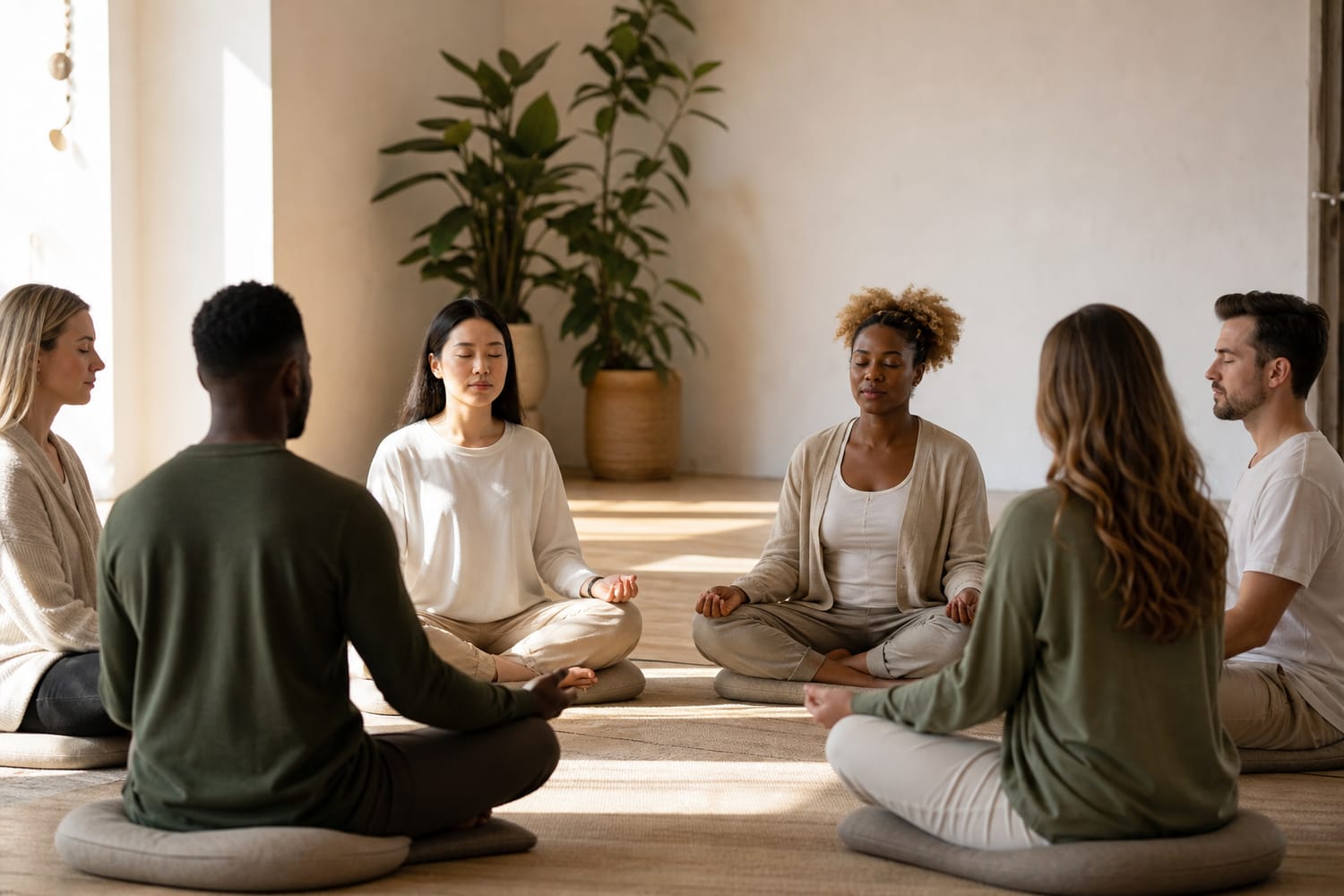
Now picture the same ten minutes in a quiet room with a handful of other people, all sitting still, all doing the same thing. Something shifts. You stay. You settle. The distractions that usually win lose their grip.
That is the quiet power of group meditation. It is the same practice, but the room does some of the work for you. Here is what meditating with others actually gives you, and how to find a group near you.
Why meditating with others works
A lot of people assume meditation is meant to be solitary. Just you, your breath, and a cushion. Solo practice is brilliant, and it should be the backbone of your habit. But it asks you to provide all the motivation, all the focus, and all the consistency on your own. On a flat day, that is a lot to ask.
A group changes the maths. You borrow the focus of the room. You show up because others are expecting you. You keep going because you are not the only one doing it. None of this is mystical. It is simply how people work. We do hard things more easily in good company.
An honest word before I sell you on it
I should be straight with you, because it matters here. I have not done this myself. I meditate alone, and I have hesitated over group sessions for exactly the reason you might be hesitating. I suspect I would feel self conscious, and that I would spend the first ten minutes quietly wondering what everyone else was doing instead of settling into anything. There are a few groups near me and I may well go at some point.
I am telling you that because if the same thought has been putting you off, you are not being precious. It is the single most common reason people never try one. And it is worth noticing what the room is actually like. Everyone has their eyes closed. Nobody is watching you. The self consciousness you are imagining is the one thing a room full of people meditating is structurally incapable of delivering.
The real benefits of group meditation
Built in accountability
The biggest reason meditation habits collapse is that nothing happens if you skip. A group fixes that gently. A set time and a few familiar faces give you a reason to turn up, even when your motivation is running low. The habit stops depending purely on willpower.
Deeper focus
There is something about a room full of still, quiet people that helps your own mind settle. The shared silence holds you. Distractions that would derail you at home tend to fade when everyone around you is doing the same thing. Many people report dropping into a deeper state in a group than they manage alone.
A sense of belonging
Meditation can feel lonely, and modern life is short on places where you simply sit quietly alongside others with no agenda. A meditation group offers exactly that. A sense of belonging and shared purpose that lingers well after the session ends. For a lot of people, the connection is as valuable as the practice itself, and that is not a soft benefit. The World Health Organization now treats social connection as a health issue in its own right, linking it to better health and a lower risk of early death.
Learning from others
In a group you pick things up you would never find alone. A teacher offers gentle guidance. Other members share what works for them. You try techniques you would not have thought to try. Your practice grows faster because you are not figuring it all out by yourself.
Motivation that carries over
A good session leaves you inspired, and that inspiration follows you home. People who meditate in a group often find their solo practice gets stronger too. The group tops up your motivation, and you carry it into the days in between.
How to find a meditation group near you
The good news is that meditation communities are easier to find than ever. A few places to look:
Search Meetup and local listings. Meetup is full of meditation groups, many of them free or donation based. A quick search for your town plus meditation usually turns up more than you expect.
Check community noticeboards. Libraries, cafes, yoga studios, and wellbeing centres often pin up local class details.
Ask around. Word of mouth is still one of the best ways in. If a friend meditates, ask where.
Look online. Plenty of groups now meet over video too, which means you can join from your front room and still get the shared focus of a live session.
Try a local studio or centre. Yoga studios, Buddhist centres, and wellbeing spaces frequently run drop in sessions that welcome complete beginners.
Getting the most from a group session
Once you have found a group, a few simple things help you settle in.
Drop your expectations. You do not need to feel anything profound. Turn up, follow along, and let the session be whatever it is.
Set a gentle intention. Something simple like staying open, or being kind to yourself, gives your practice a quiet direction.
Let the room carry you. On the days your focus is thin, lean on the shared stillness. That is what it is there for.
Be a good part of the space. Arrive on time, keep your phone away, and help make the room calm and welcoming for everyone in it.
If you are still finding your feet with the basics, our beginner’s guide to mindfulness meditation will get you comfortable before you join a group, and if you want a reminder of why any of this is worth the effort, the 20 benefits of meditation covers what a regular practice does for your mind and body.
Bring your practice into good company
Solo meditation will always be the foundation. It is flexible, free, and yours whenever you need it. But if your practice has gone stale, or you have never quite made it stick, a group might be the missing piece. The accountability, the shared focus, and the simple comfort of sitting with others can turn meditation from a chore you keep abandoning into something you look forward to.
Find one session near you and just go. You do not need to be good at it. You only need to turn up and sit down. For more ways to deepen a practice, the Mindfulness, Meditation & Nervous System collection is full of gentle next steps.
When you want a simple place to start, our free 7 Day Mindset Reset gives you one small shift a day to quiet your inner critic. It pairs well with a new meditation habit and takes about three minutes to read.