There is a particular kind of tired that comes from running your life on an operating manual written for a different brain.
You have read the productivity advice. Wake at five. Keep a minimalist planner. Just do the important thing first. And you have watched it all work beautifully for other people while your version collapses by Thursday, leaving you with the same old conclusion: the problem must be me.
Let us retire that conclusion. If you are a neurodivergent adult, ADHD, autistic, dyslexic, dyspraxic, or some blend the labels have not quite caught up with, your struggles are mostly a design mismatch, not a character flaw. And design, unlike character, is something you can change this week.
This is a long, practical guide to doing exactly that: organisation that fits your brain, energy management that respects your battery, and self belief rebuilt on evidence instead of wishful thinking.
The mindset shift that makes everything else work
Before the tips, one reframe, because without it every system below eventually becomes another stick to hit yourself with.
You have spent years, probably decades, measuring yourself against a neurotypical standard: consistent output, tidy linear days, effort in proportion to importance. Against that ruler you keep coming up short, so you conclude you are lazy, flaky or broken.
But the ruler was never calibrated for your brain. Neurodivergent brains genuinely run differently: interest and urgency drive motivation more than importance, working memory drops things without warning, energy arrives in waves rather than a steady stream. None of that is a moral failing. It is a spec sheet.
And here is what changes when you actually accept the spec sheet: you stop spending energy trying to become a different machine, and start spending it building a life that fits the one you are. The washing machine does not shame itself for not being a dishwasher. It just gets used for what it is brilliant at.
If your particular flavour includes the ADHD motivation cliff, the guide on ADHD and motivation goes deep on why your brain sorts tasks by interest rather than importance, and how to work with that instead of against it.
Organisation: externalise everything
The golden rule of neurodivergent organisation is brutally simple: your environment should remember so your brain does not have to.
Working memory is the shelf where your brain holds “things to deal with soon”. For many neurodivergent adults that shelf is small and things slide off it silently. The fix is not trying harder to remember. It is refusing to store anything important in your head at all.
Make it visible or it does not exist
Object permanence issues are real: out of sight genuinely becomes out of mind. So stop fighting it.
This section is written from experience. My meds and vitamins live in the kitchen, in plain view, because breakfast happens there and the seeing does the remembering. Everything in my house has a specific home, and I know precisely what happens when something leaves its home: I recently spent an hour and a half turning the place upside down for an old phone I needed data from, and finally found it in the loft, where a tidier past version of me had put it. The system is not decoration. The system is the memory.
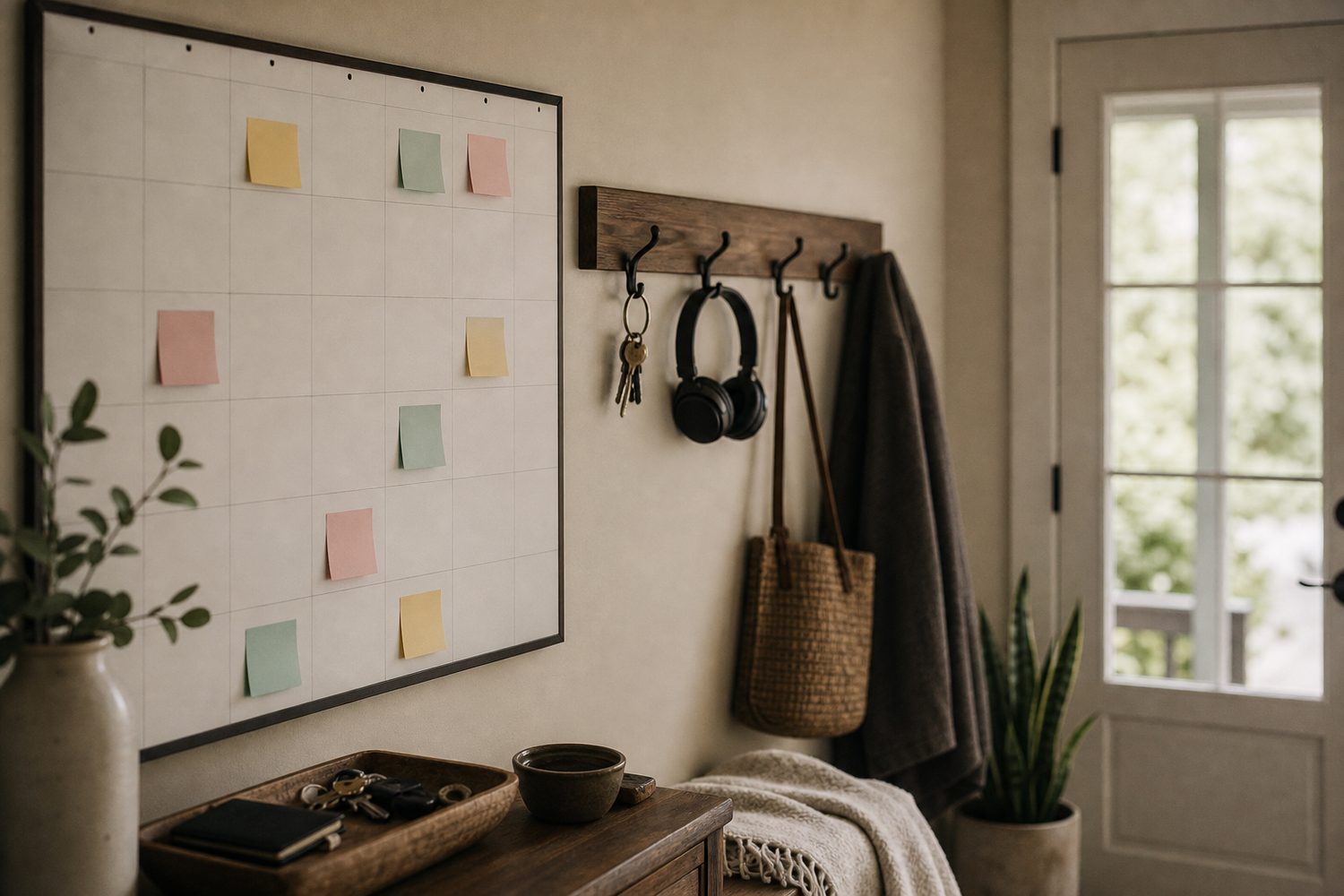
Keep medication next to the kettle, not in a cabinet. Use open shelving, clear containers and hooks instead of drawers and cupboards for daily items. Put tomorrow’s important thing physically in front of the door. A visual wall planner beats a beautiful app you have to remember to open, because the wall ambushes you with the information whether you asked or not.
One inbox, one calendar, everything captured
Scattered systems die. A note here, a reminder there, a promise made verbally in a corridor, each is a separate shelf for your working memory to drop.
Pick one capture point, a notes app, a pocket notebook, voice notes, whatever you will actually use, and develop a single reflex: the moment something enters your head, it goes in the inbox. Not filed, not organised, just captured. Then one calendar for everything with an alarm on every entry, because a neurodivergent calendar without alarms is just a diary of things you missed.
Shrink the system until it survives your worst week
Elaborate planning systems work for about nine days, then one bad day breaks the streak and the whole thing collapses in a pile of shame. The problem was never your discipline. It was the size of the system.
A planning system you can run on your worst day, three priorities on a sticky note, one alarm reviewed at breakfast, is worth ten beautiful bullet journals. Build for the low capacity days and the good days take care of themselves. There is a full method for this in ADHD routines that don’t fall apart, a kit list in our roundup of planning tools for autistic and ADHD adults, and a morning specific version in neurodivergent friendly morning routines.
Use bridges, not willpower, to start tasks
Task initiation, the gap between deciding to do a thing and your body actually starting it, is often the single hardest part of executive function. Some bridges that work:
- The two minute entry. Do not “clean the kitchen”. Put one plate in the dishwasher. Starting is the whole battle, and momentum is a real force. On the days even that will not start, the guide to executive dysfunction on bad days has the full triage.
- Body doubling. Another person working quietly alongside you, in the room or on a video call, lowers the starting threshold dramatically. Nobody fully knows why it works this well. It does.
- Pair the dull with the pleasant. A dedicated podcast that only plays during laundry. The nice coffee that only appears with the admin. You are manufacturing the interest your brain needs to engage.
- Change the location, reset the brain. Stuck at the desk? The same task at the kitchen table or a café often unsticks purely from novelty.
Energy: the real currency
Neurotypical productivity manages time. Neurodivergent life runs on a scarcer resource: energy. You can have a completely free afternoon and still be unable to do the thing, because the tank is empty in a way a nap does not fix.
Learn your actual drains
Energy accounting starts with honesty about what costs you. The big three for most neurodivergent adults:
Masking. Performing a more neurotypical version of yourself, suppressing stims, forcing eye contact, scripting small talk, is one of the most expensive things you do, and it is often invisible because it looks like “just being at work”. If you come home from social days utterly hollow, this is likely why.
Sensory load. Noise, bright lights, scratchy fabric, busy visual environments: each is a small tax that compounds across a day. An open plan office can cost more energy than the work done in it.
Task switching. Every context switch has a toll booth. Ten small interruptions can drain more than three hours of settled focus.
None of these show up in a normal diary, which is why you can look at a “light” week and not understand why you are on your knees.
Budget like it is money
Once you know your costs, spend deliberately. If Thursday holds a big social event, Thursday does not also hold the supermarket and the difficult phone call. If mornings are your reliable energy window, guard them for the work that matters and push admin to the afternoon slump.
And schedule recovery like it is an appointment, because it is. I have burned out more than once from taking on too much at the same time, and it taught me the lesson the hard way: rest still comes with a stab of guilt when the project list is long, but the guilt is cheaper than the crash. Quiet decompression after high mask days is not a treat. It is maintenance the rest of your life depends on. Headphones, dim light, familiar comfort media, alone time: whatever refills you, it goes in the calendar with the same status as a meeting.
Respect the wave pattern
Neurodivergent capacity is tidal. Some days you will do a fortnight of work in six hours; some days replying to two emails is the summit. Both are real, and neither is a promise about tomorrow.
Ride the wave rather than fighting it: on high days, do the heavy lifting and resist the urge to also raise your baseline expectations. On low days, run the minimum viable routine and drop the shame. A sustainable average beats a heroic fortnight followed by a month of burnout, every single time. If anxiety is part of your low day picture, a few minutes of breathing exercises can genuinely lower the physical noise floor.
Working life: design the container, not just the tasks
The systems above assume you control your environment. At work, you often do not, so the strategy shifts: negotiate the container your brain operates in.
Ask for the version of the job that suits your wiring. Most managers do not care how the work happens, they care that it happens. Written briefs instead of verbal instructions. Deadlines with interim checkpoints rather than one distant cliff. Meetings clustered into one part of the day so focus time survives in unbroken blocks. Noise cancelling headphones as standard kit. None of these are exotic requests, and in many places you do not even need to mention neurodivergence to ask for them; they are just “how I work best”.
If you are in the UK, know the phrase “reasonable adjustments”. Under the Equality Act, diagnosed conditions like ADHD, autism and dyslexia entitle you to workplace adjustments, and the government’s Access to Work scheme can fund coaching, software and equipment. You do not have to be struggling dramatically to qualify. Plenty of people white knuckle their way through jobs that a few adjustments would transform.
Choose battles by energy cost, not just salary. A job that pays slightly more but demands eight hours of masking in a loud open plan office can be a worse deal than it looks, because you spend your evenings and weekends recovering instead of living. When you weigh options, price the sensory and social load honestly. The spreadsheet never includes it. Your body always does.
Disclose strategically, not confessionally. Telling people is a tool, not an obligation. Some workplaces respond brilliantly, some do not, and you are allowed to test the water with small requests before deciding how much to share.
Let the safe people in
One more system, and it might be the highest leverage of all: stop running the whole operation solo.
Masking around everyone, including the people who love you, doubles the cost of every relationship. Pick the safest one or two people in your life and let them see the real operating system. Tell them what a shutdown looks like so they do not read it as sulking. Tell them that a low battery day is not about them. Tell them what actually helps, and just as importantly, what does not.
Two sentences do a lot of work here: “My brain does not do X well, so I handle it with Y” and “If I go quiet, it is my battery, not you.” People who care about you mostly want the manual. Handing it over is not a burden on them. It is intimacy, and for many neurodivergent adults it is the first time a relationship stops being a performance.
Self belief: rebuilt on evidence, not affirmations
Here is the quiet wound underneath the practical stuff. By the time most neurodivergent people reach adulthood, they have absorbed thousands of corrections: you are not trying, you are too much, you are not living up to your potential. That sediment settles into a core belief. I am the problem.
I know that sediment personally. I was diagnosed autistic and ADHD in the summer of 2025, and my life started to make sense in so many different ways at once. Years of soaking up projections from school and workplaces, the steady message that I was not good enough, had quietly eroded my confidence. Part of what rebuilt it was deliberately looking back at what I had actually achieved despite all of it, real evidence, on the record, and that is what gave me the belief and the motivation to chase my own goals properly. Which is exactly why this section is about evidence.
Affirmations bounce off that belief, because you do not believe them. What actually rebuilds self belief is evidence, gathered deliberately.
Keep a done list
At the end of each day, write down three things you did. Not achievements by anyone else’s standard. Things you did: made the phone call, showed up to work while overstimulated, fed yourself properly. Your brain’s negativity filter deletes these within hours, so the list exists to catch them before they vanish.
Read it back at the end of a week and something shifts. The story of “I did nothing” stops surviving contact with the record.
Separate the struggle from the self
Practise one specific language change: from “I am useless at this” to “this task is expensive for my brain”. The first is an identity verdict. The second is an engineering observation that immediately suggests solutions, make it visible, add a bridge, do it in the morning window, ask for help.
This is the same inner critic work covered in how to stop being so hard on yourself, and it matters double here, because the neurodivergent inner critic has usually had outside help writing its material. If criticism and rejection hit you with physical force, that has a name and a toolkit too: how to cope with rejection sensitivity.
Count the strengths honestly
Design mismatch cuts both ways, and the same brain that cannot force focus on a dull form can do things the neurotypical manual never mentions: hyperfocus that produces a fortnight of work in a day, pattern recognition that spots what everyone else missed, deep honesty, creative leaps, fierce justice sensitivity, encyclopaedic depth in the things you love.
These are not consolation prizes. In the right environment they are the whole game. Which is why the long term project of neurodivergent adult life is not fixing yourself. It is steering toward the environments, work, relationships and routines where your spec sheet is an advantage.
Build your version, not the manual’s
If you take one thing from this guide, make it this: stop renting a life design built for a different brain, and start building your own.
Start smaller than feels impressive. Pick one thing from this page, a visible wall planner, a two minute entry into a dreaded task, a done list before bed, and run it for a week. Not all of it. One thing, small enough to survive your worst day.
Because the goal was never to pass as neurotypical. The goal is a life where your brain, the actual one, with its tides and its brilliance and its blank Tuesdays, gets to work with the current instead of against it.
You were never the problem. The manual was. Time to write yours.