An email lands. Your chest tightens before you have even read the second line. Your breath goes shallow and quick. Your jaw clenches. Someone says “just relax” and it might be the least helpful sentence in the English language, because your body is not listening to words right now.
You already know you cannot think your way out of this. You have tried. The reassuring self talk, the logic, the reminders that it will be fine. None of it reaches the part of your brain that has already pressed the alarm.
But there is something your nervous system will listen to, even when thoughts bounce off the walls. Your breath.
Why slow breathing stops anxiety when thinking cannot
When anxiety spikes, your sympathetic nervous system takes the wheel. Heart rate climbs. Muscles tense. Digestion slows. Your body is preparing to fight or run, and it does not care that the threat is a passive aggressive email, not a predator.
Here is the part most people miss. You cannot talk your nervous system out of that state. It does not process language. But it does monitor one thing constantly: how you breathe.
A short, shallow breath confirms the alarm. A long, slow exhale does the opposite. It activates the parasympathetic branch of your nervous system, including the vagus nerve, and sends a clear signal: the danger has passed. Heart rate drops. Muscles begin to release. The fog of panic starts to thin.
This is why “just think positively” or “just calm down” never works in the moment. Your prefrontal cortex, the rational thinking part of your brain, has already been sidelined by the amygdala. But the breath bypasses that entirely. It speaks directly to your nervous system in a language it actually understands.
This is not a mindset trick. It is basic physiology. And it works whether you believe in it or not, which is exactly what makes it useful in a crisis. It is also standard advice rather than fringe: the NHS recommends breathing exercises as a first line way to ease stress and anxiety.
The best part? You do not need an app, a quiet room, or ten spare minutes. Two minutes is enough. Sometimes one breath is enough.
Three breathing exercises for anxiety you can use right now
Each of these techniques works a little differently. The right one depends on how much time you have and what you need in the moment.
The physiological sigh: a one breath reset
This is the fastest option. Neuroscientist Andrew Huberman popularised it, but your body already does it naturally. It happens when you cry. It happens right before you fall asleep.
How to do it:
- Breathe in through your nose.
- At the top of that inhale, take a second short sniff in, filling your lungs completely.
- Let out a long, slow exhale through your mouth.
That is one cycle. One single breath. Do it once and you will notice your shoulders drop. Do it three times and the effect deepens.
When to use it: In the middle of a meeting. At your desk. Walking to pick up the kids. Any moment when you need to reset fast without anyone noticing. It is especially useful when anxiety hits without warning and you need something that works in a single breath.

Box breathing: steady and structured
Box breathing uses equal counts for each phase. It gives your mind something specific to follow, which is especially helpful if racing thoughts are part of the picture.
How to do it:
- Breathe in through your nose for a count of four.
- Hold your breath for a count of four.
- Breathe out through your mouth for a count of four.
- Hold again for a count of four.
- Repeat for four rounds.
Four rounds takes roughly two minutes. The symmetry of it is calming in itself. Your brain latches onto the pattern and the anxious spiral loses its grip.
When to use it: When you have a minute or two and want something structured. Before a difficult conversation. During a break between tasks. It is the same technique Navy SEALs use under pressure, so it can certainly handle a tough Monday.
The 4 7 8 method: the wind down for sleep
If you have ever lain awake at three in the morning with your mind churning, this one is for you. The extended hold and exhale slow your system right down. It is one of the most effective breathing exercises for anxiety to sleep.
How to do it:
- Breathe in quietly through your nose for a count of four.
- Hold your breath for a count of seven.
- Exhale slowly and completely through your mouth for a count of eight.
- Repeat for three to four rounds.
The long exhale is the key. It tips the balance firmly toward your parasympathetic nervous system and tells your body it is time to rest.
When to use it: In bed before sleep. During a quiet moment in the evening when you want to wind down. If you struggle with insomnia, pair this with the practical steps in the guide to tackling insomnia and sleep problems.
The 3 3 3 grounding rule for anxiety
Sometimes the breath alone is not enough to interrupt the spiral. Your mind is moving too fast to focus on counting. That is where the 3 3 3 rule comes in.
This is a sensory grounding technique. It works by pulling your attention out of your head and into your immediate surroundings.
How to do it:
- Name three things you can see. The edge of your laptop. A mug. The light on the wall. Be specific.
- Name three things you can hear. Traffic outside. The hum of a fridge. Your own breathing.
- Move three parts of your body. Roll your shoulders. Wiggle your fingers. Press your feet into the floor.
That is it. The whole thing takes about thirty seconds and it works because anxiety lives in the future. It feeds on “what if.” The 3 3 3 rule drags you back to right now, where you are safe.
Once you have grounded yourself, your breathing technique will land much more effectively. Think of the 3 3 3 rule as clearing the runway so the breath can do its work.
Your two minute reset sequence
Imagine you are at your desk. A wave of anxiety hits and your body tightens. Here is a simple sequence you can run through in about two minutes, wherever you are.
Step one: recognise and name it. Say to yourself, quietly or silently, “This is anxiety. My body is reacting.” Naming the feeling creates a tiny bit of distance between you and the sensation. That distance is everything.
Step two: ground with 3 3 3. Three things you see. Three you hear. Three body parts you move. Thirty seconds, maximum.
Step three: breathe. Choose the physiological sigh for a quick reset, or box breathing if you want something more structured. Three to five rounds.
Step four: check back in. Notice what has shifted. Your heart rate may still be elevated, and that is fine. You are not aiming for bliss. You are aiming for “I can handle this.” That is enough.
The clearest example I have of this working is a job interview. I had worked myself into a proper state beforehand, running through every possible way it could go wrong, and the more I thought about it the worse it got. Thinking was never going to get me out of that, because thinking was the thing doing it to me. So I did a simple breathing exercise. Nothing clever. Slow breaths, with the exhale longer than the inhale. It did not make me suddenly confident, and it was not supposed to. What it did was bring me back into the room and take the edge off, enough that I could walk in as myself rather than as someone braced for disaster.
If counting the breath feels like one more thing to manage when you are already overwhelmed, the free guided Breathing tool paces everything for you. It handles the timing so you can close your eyes and just follow along. No counting, no guesswork. Try it next time the anxiety spikes.
Breathing is a tool, not a cure
Let us be honest about what breathing exercises can and cannot do. They are brilliant at interrupting the acute stress response. They bring your nervous system back toward baseline. They give you a way to act when thinking fails.
They are not a replacement for professional support. If your anxiety is persistent, if it is affecting your work or relationships, if the waves keep coming and these resets only hold them back for a few hours, please talk to your GP. Breathing exercises and therapy are not competing options. They work together.
For a deeper look at how breathwork fits into a broader nervous system practice, the complete guide to breathing techniques for calming your nervous system covers more approaches and the science behind them. And if you want to explore other practical tools alongside your breathwork, the Mindset Tools hub has everything in one place.
One breath is a real starting point
You do not need to overhaul your life to manage anxiety better. You do not need a morning routine, a journal, or a retreat. You need one long exhale.
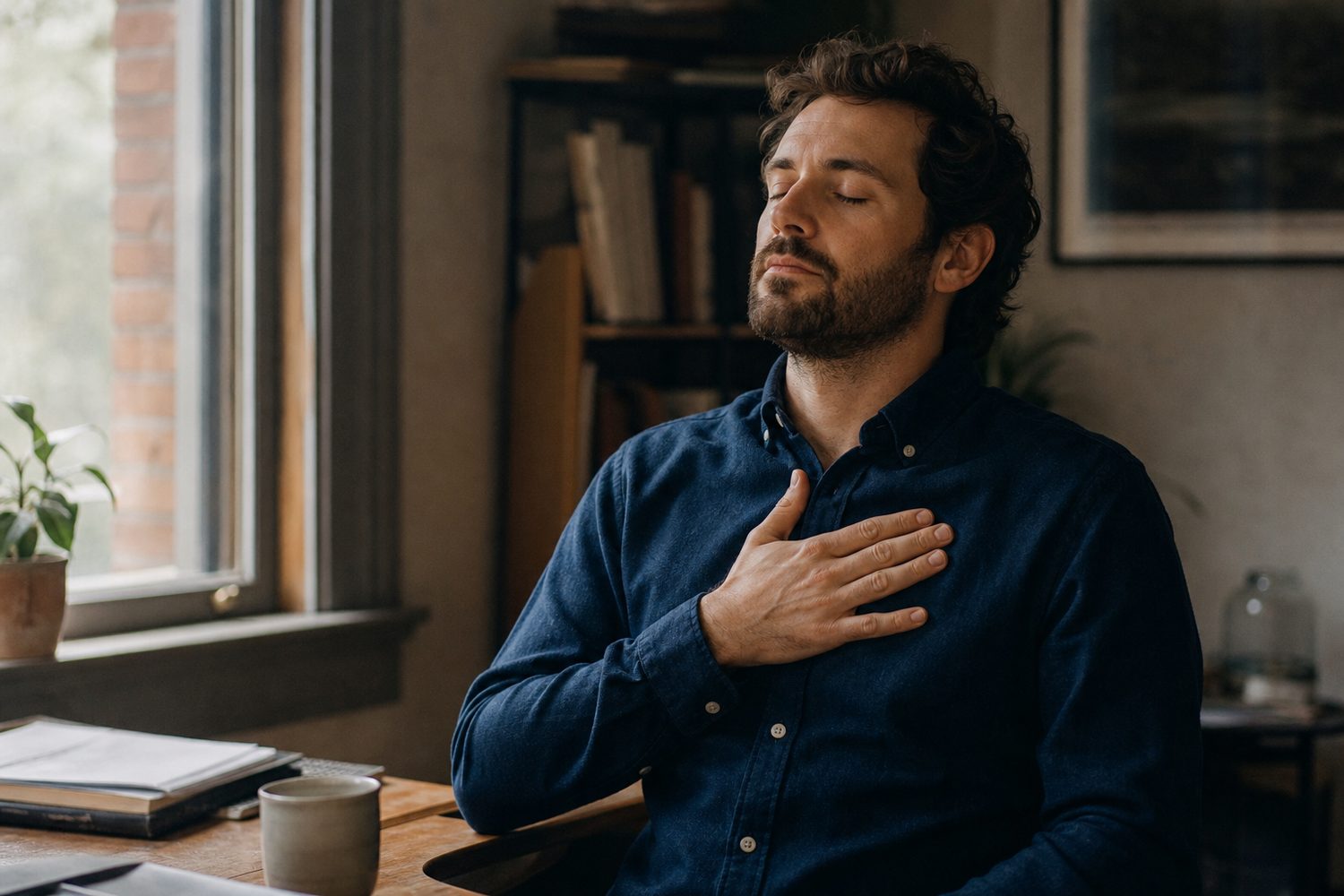
Start there. The next time your chest tightens and your thoughts start racing, skip the self talk. Skip the “just relax.” Put your hand on your chest, take a double inhale through your nose, and let out the longest exhale you can.
That single breath is not nothing. It is your nervous system hearing, for the first time in that moment, that it is safe to stand down. Sometimes that one breath is all it takes to find the next clear thought. The next calm decision. The next steady step.
You have been breathing your whole life. Now you know how to use it on purpose.