
You set an alarm for six. You lay your gym clothes out. You even prepped overnight oats because that is what people with good habits apparently do. Monday goes brilliantly. Tuesday is fine. Wednesday is a push. By Friday you are eating toast over the sink at ten past eight and the gym bag has not moved.
Sound familiar?
You are not lazy. You are not broken. You just tried to build a habit the way most people are told to, and that way does not work for most people.
This post is going to walk you through how to build a habit that genuinely lasts. Not with willpower. Not with a perfect morning routine downloaded from a stranger on the internet. With a framework that works with your brain instead of against it.
Why Most New Habits Fail (and It Is Not Willpower)
There is a persistent myth that building a habit is about discipline. Grit your teeth, push through, and after 21 days it will be automatic.
That 21 day number comes from a 1960s observation by a plastic surgeon called Maxwell Maltz. He noticed his patients took about 21 days to adjust to their new appearance. Somehow that became “it takes 21 days to form a habit,” which is a bit like saying it takes the same time to learn to drive as it does to get used to a new haircut.
The truth is, willpower is a terrible foundation for habit formation psychology. It is a limited resource. It gets used up by decisions, stress, tiredness, and the hundred small demands your day throws at you before lunch. Relying on willpower to sustain a new behaviour is like relying on a phone at three percent battery to get you through the evening.
Most habits fail for three reasons.
The behaviour is too big. You go from nothing to an hour at the gym five days a week. Your brain treats the gap between where you are and where you want to be as a threat and quietly steers you back to the sofa.
There is no anchor. The new behaviour floats free in your day with no trigger to start it, so you have to remember it, decide to do it, and push yourself every single time.
There is no reward. Not a big reward. A small one. Something your brain registers as “that was worth doing.” Without it, the behaviour stays effortful instead of becoming automatic.
If you want to know how to form a habit that sticks, you need to fix all three.
How Long It Actually Takes to Form a Habit
A study from University College London tracked people trying to build new habits and found the average was 66 days. But the real range was enormous. Some people locked in a simple habit in 18 days. Others needed 254 days for something more complex. The researcher behind that study, Dr Pippa Lally, has since stressed that 66 is a rough average, not a fixed deadline you are failing against.
The takeaway is not a magic number. It is this: consistency matters infinitely more than speed. You do not need to be perfect. You need to keep showing up, imperfectly, for longer than you think.
That can feel discouraging if you are used to quick results. But think about it the other way. If a habit took root in 21 days, it would also be easy to lose. The reason lasting habits take time is that your brain is literally rewiring itself. New neural pathways are forming. That takes repetition, not intensity.
So stop asking “how long to form a habit” as if there is a countdown timer. Start asking “how can I make this easy enough that I will still be doing it in three months?”
That question changes everything.
A Three Layer Framework: Make It Tiny, Anchor It, Make It Rewarding
This is the core of how to build a habit. Three layers. Each one removes friction so you do not need willpower to carry you.
Layer One: Make It Tiny
Whatever behaviour you want to build, shrink it until it feels almost too easy.
Want to meditate? Start with one minute. Want to journal? Write one sentence. Want to run? Put your trainers on and step outside. That is it for today.
This is the principle behind atomic habits: make the behaviour so small that not doing it feels stranger than doing it. You are not training the full behaviour yet. You are training the act of showing up. Once showing up is automatic, you can build.
Layer Two: Anchor It to an Existing Routine
Your brain already has dozens of habits it runs on autopilot. Brushing your teeth. Boiling the kettle. Sitting down at your desk. These are your anchors.
Attach your new habit directly to one of them. “After I boil the kettle, I write one sentence in my journal.” “After I sit down at my desk, I open my to do list and pick one thing.”
The anchor does two things. It removes the decision of when to start. And it borrows momentum from something you already do without thinking.
Layer Three: Make It Rewarding
This does not mean bribing yourself with chocolate every time you meditate, although honestly, that is not the worst idea in the first week.
Your brain needs a signal that the behaviour was worth doing. That can be as simple as ticking a box on a tracker, saying “done” out loud, or pausing for a second to notice that you feel slightly better than you did five minutes ago.
Small rewards keep the feedback loop alive. Without them, the habit stays in your conscious brain, requiring effort every time. With them, it starts sinking into the automatic part of your brain where real habits live.
One of the healthiest habits I have built came together exactly this way, one small swap at a time. It started with choosing squash over fizzy drinks and simply not putting biscuits or sugary snacks in my weekly shop, so the temptation was never in the house to begin with. Once that felt normal, I moved on to cooking proper meals instead of grabbing ready made processed ones. With a bit of planning you can batch cook and meal prep, so it ends up healthier and cheaper without eating your evenings. None of it was a dramatic overhaul. It was one tiny, doable change stacked on the last one.
The 3 3 3 Rule: A Simple Structure for Your Day
Once you have a habit or two in place, the 3 3 3 rule gives your day a shape that supports them.
The idea is straightforward. You spend 3 hours on your most important deep work. Then you handle 3 shorter tasks that keep things moving. Then you do 3 maintenance activities: things like exercise, tidying, cooking, or personal admin.
You do not need to follow it rigidly. The value is in the structure. Instead of waking up and facing an undifferentiated mountain of things to do, you have three clear categories. That means less decision fatigue, which means more energy left for the behaviours you are trying to build.
If you have ever wondered what are the 7 daily habits that make the biggest difference, the 3 3 3 rule is a solid container for most of them. Deep work covers your professional growth. The shorter tasks keep your life from falling apart. And the maintenance block is where exercise, reading, and reflection naturally slot in.
The key is giving your new habits a home in the structure rather than hoping they will squeeze into whatever time is left over. Time that is left over does not exist. You have to claim it.
Seven Daily Habits That Compound Over Time
There is no single perfect set of daily habits. But research and lived experience keep pointing to the same handful. Here are seven that compound, meaning they do not just help on the day you do them. They make the next day better too.
Move your body. Not necessarily the gym. A walk counts. A stretch counts. Ten minutes of movement shifts your mood, clears your thinking, and makes sleep easier later.
Drink enough water. Boring, yes. But even mild dehydration makes you tired, foggy, and more likely to reach for something you will regret. Keep a glass or bottle within arm’s reach.
Read or learn something new. Even ten pages. Even one article. This keeps your brain growing and gives you something more interesting to think about than whatever your anxiety is serving up today.
Write down what you are grateful for. Not as some forced positivity exercise. Because your brain has a negativity bias and gratitude practice is one of the few things proven to counteract it. One to three things. Takes thirty seconds.
Spend a few minutes in stillness. Meditation, breathing, sitting quietly without a screen. Your nervous system needs moments where nothing is being asked of it.
Do one task that moves a goal forward. Just one. Not five. One thing that, when done, means you are closer to something that matters to you. This is where optimistic goal setting meets daily action. The goal gives the habit meaning. The habit gives the goal traction.
Reflect briefly on how the day went. Not a full journal entry unless you want to. Just a moment to notice what went well. What would you do differently? This is where learning actually happens.
You do not need all seven from day one. Pick the one that calls to you and do it for a month. Then add another.

Build Better Habits in Four Steps
If you want a clear process for any habit you are trying to build, here it is in four steps.
Step One: Choose Your Trigger
A trigger is the moment that tells your brain “it is time.” It can be a time of day, a location, or an existing routine. The more specific, the better. “After I close my laptop at the end of the workday” is a better trigger than “in the evening.”
Step Two: Define the Atomic Behaviour
This is the tiniest version of the habit. Not the aspirational version. Not the Instagram version. The version so small that you cannot fail at it. One press up. One page. One glass of water. Make it easy to start and your brain will stop resisting the beginning.
Step Three: Add a Reward
Mark it done. Tick a box. Say it out loud. Feel the small satisfaction of having kept a promise to yourself. This step is easy to skip, but it is the one that tells your brain “let’s do that again.”
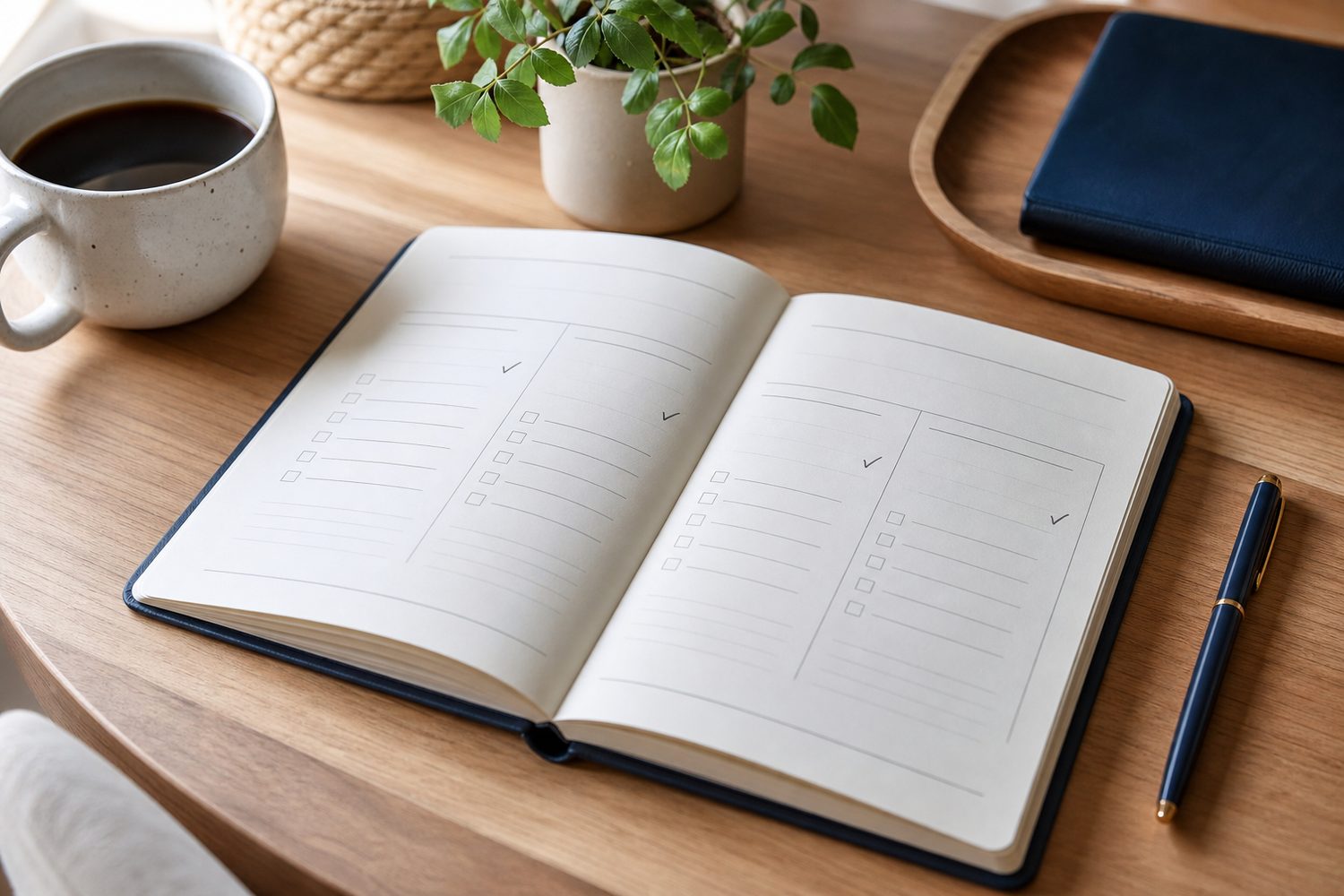
This is where tracking matters. Seeing a row of ticks builds momentum in a way that trying to remember whether you did the thing yesterday never will. Try the free Habit Tracker to keep it simple. No complicated setup. Just the behaviour, the tick, and the streak.
Step Four: Track and Adjust
After a week, check in. Is the trigger firing reliably? Is the behaviour still small enough? Do you feel anything when you tick it off?
If something is not working, change it. Move the trigger to a different part of the day. Shrink the behaviour further. Add a better reward. The goal is not to follow a rigid system. The goal is to keep the loop running.
Tracking also shows you something powerful: that you are more consistent than you think. Most people focus on the days they missed and ignore the days they showed up. A tracker flips that. You can explore all of our free tools at the mindset tools hub.
How to Build a Habit With ADHD or a Neurodivergent Brain
If you have ADHD, autism, or another form of neurodivergence, everything above still applies. But there are a few things worth adjusting.
Novelty matters more. A neurotypical brain can sustain a mildly boring habit for weeks on routine alone. A neurodivergent brain often needs variety or novelty to stay engaged. Change the music you listen to while you do the habit. Move it to a different room. Pair it with something you enjoy. Keep the core behaviour the same but let the context shift.
Smaller is even more important. Executive function issues mean the gap between “I should do this” and “I am doing this” is wider. Make the starting step absurdly small. Not “exercise for twenty minutes” but “put your trainers on.” The activation energy has to be almost zero.
External accountability helps. Not because you lack discipline. Because your working memory might quietly drop the habit from your awareness. A reminder on your phone, a visual cue, a friend who checks in, or a habit tracker that shows your streak can all serve as the external scaffolding your brain needs.
Forgive the inconsistency. Neurodivergent brains are not wired for daily sameness. You might nail it for twelve days, miss three, then come back strong. That pattern is not failure. It is how your brain works. Measure by direction, not by perfection.
For a deeper look, our full guide on building routines with ADHD goes further into systems that work with your brain rather than against it.

When You Slip: Come Back Without the Shame Spiral
Imagine you have been journaling every morning for two weeks. It is going well. You feel calmer, more organised, more like the person you want to be. Then one morning you oversleep. The next morning is chaos. By the third morning you think, “Well, I already broke the streak. What is the point?”
That voice is not wisdom. It is shame wearing a logical costume.
Missing a day does not reset your progress. Your brain does not delete the neural pathways it has been building just because you had a rough Wednesday. What actually breaks a habit is not the slip. It is the story you tell yourself about the slip.
Here is a more useful story: you are a person who journals most mornings. Not every morning. Most mornings. That is enough.
The research backs this up. People who show themselves compassion after missing a habit are significantly more likely to return to it than people who beat themselves up. Criticising yourself feels productive. It is not. It just adds shame to the pile, which makes the next attempt heavier.
So if you slip, notice it, shrug, and do the behaviour the next time the trigger fires. No guilt. No restart. Just keep going.
A Quick Habit Building Checklist
Before you close this page, run through this list. It takes two minutes and it will double the odds of your habit lasting past the first week.
Pick one habit. Just one. Not three. Not five. One.
Shrink it. Find the smallest possible version. If it takes more than two minutes, shrink it again.
Anchor it. Attach it to something you already do every day. Write down the sentence: “After I [existing habit], I will [new habit].”
Choose your reward. A tick on a tracker, a moment of acknowledgement, or something small you enjoy.
Set up your tracker. Whether it is a notebook, an app, or the free Habit Tracker on this site, make your consistency visible.
Tell one person. Accountability is not about pressure. It is about having someone who will gently ask, “How is that thing going?”
Set a review date. Put a reminder in your phone for one week from today. When it fires, check in honestly and adjust whatever needs adjusting.
That is it. No overhaul. No new life plan. Just one small behaviour, repeated until it stops requiring effort.
You Already Know How to Do This
You have already built dozens of habits without trying. You check your phone when you wake up. You reach for the kettle before you are fully conscious. You take the same route to work, sit in the same seat, reach for the same mug.
Your brain is a habit machine. It is phenomenally good at this. The only difference with a deliberate habit is that you are choosing the behaviour instead of falling into it.
So do not tell yourself you are bad at habits. You are exceptional at habits. You just have not pointed that skill at something you chose on purpose yet.
Pick one thing. Make it tiny. Attach it to your day. And keep showing up.
Not perfectly. Not every single day. Just more days than not.
That is how real change happens. Not in a blinding flash of motivation on a Monday morning, but in the quiet, repeated act of doing a small thing when nobody is watching.
If you want to explore building habits alongside bigger goals and productivity systems, we have more on that too. And if you are looking for the best planners and trackers to support your new routine, we have a full guide for that too.
For now, start with one. That is always enough.