You sit down to work. You have the intention, the caffeine, maybe even the plan. Twenty minutes later you are reorganising your desk drawer, reading an article about the history of Velcro, and wondering where the morning went. Not because you are lazy. Because your brain runs on a different operating system and nobody handed you the right peripherals.
That is what focus and sensory tools actually are. Peripherals. They do not fix you, because you are not broken. They close the gap between how your brain processes the world and what the world expects from you on a Tuesday at ten in the morning.
Heads up: some links below are affiliate links. If you buy through them we may earn a small commission at no extra cost to you. It never changes what we recommend. See our affiliate disclosure for the full picture.
Start with a free focus tool for ADHD before you spend a penny
Before you add anything to a basket, try our free Habit Tracker. It lives right here on the site, it costs nothing, and it is built for brains that need visible progress to stay motivated.
Here is why it matters for ADHD. The 10 3 rule (work ten minutes, break three) is one of the simplest ways to get started on a task your brain keeps dodging. But the rule only sticks when you can see the streaks building. Our habit tracker lets you log those sessions, watch the consistency grow, and remind yourself that yes, you did show up yesterday, even when today feels harder.
Start there. If you realise you also need physical tools to support the routine, the picks below are worth a look.
How to choose the right ADHD focus tools and gadgets for adults
Not every tool suits every brain. The trick is matching the tool to the specific barrier that trips you up most. Here is how to think about it.
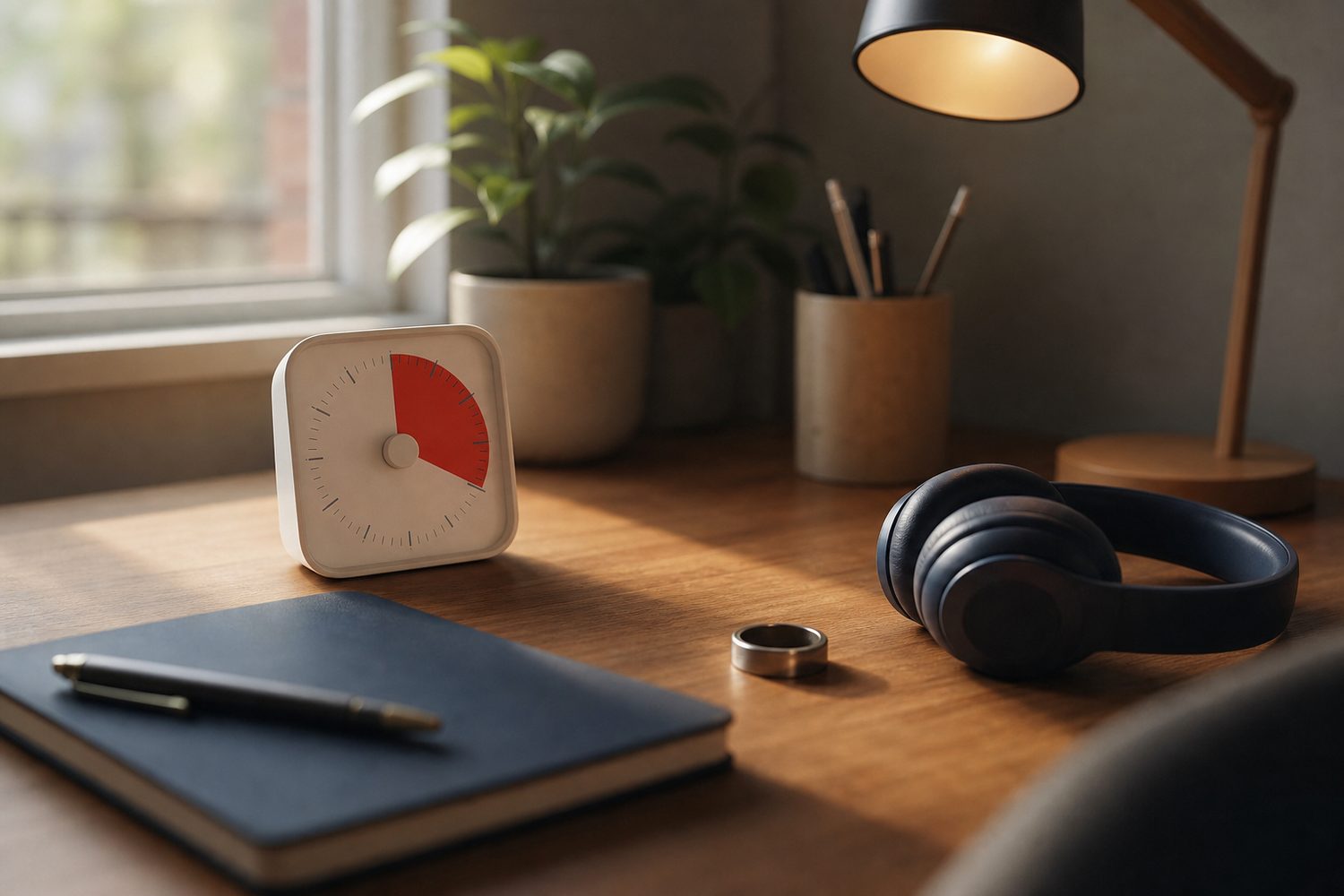
Time blindness and visual timers. If you regularly look up from a task and realise two hours have vanished, or you cannot feel the difference between five minutes and forty five, a visual countdown timer makes a real difference. This is the tool I lean on most myself: a simple digital timer I routinely set when I need to get things done. I break the job into steps, time myself on each one to turn it into a bit of a challenge, take a quick break, then move to the next step. It keeps a boring task interesting and keeps me moving forward. It turns time into something you can see shrinking in real time, which gives your brain the urgency cue it struggles to generate on its own.
Restlessness and fidget or sensory needs. Some people need their hands busy to keep their mind still. A discreet fidget tool gives your sensory system something to chew on so your attention can stay where you need it. The key word is discreet. You want something you can use in a meeting or at a coffee shop without drawing attention.
Sound sensitivity and background noise. If a ticking clock, a colleague’s keyboard, or the hum of a fridge derails your focus, you need to manage your sound environment. We have already covered this in detail. Our roundup of the best noise cancelling headphones for meditation includes picks that double as deep focus headphones, and our review of Flare Audio Calmer noise reduction earplugs covers a subtler option that takes the edge off without blocking everything out. Between those two posts you are covered.
Lighting and alertness. A dim room signals rest to your brain. A harsh overhead light creates sensory fatigue. The sweet spot is a warm, focused task lamp that tells your nervous system “this is work time” without overwhelming it. It sounds simple, but swapping your lighting can shift your alertness more than another cup of coffee.
Activation energy and environmental cues. The hardest part of any task is starting it. Environmental cues like a visible timer already counting down, a phone locked away in a box, or a weighted pad on your lap create a physical signal that it is time to begin. They lower the activation energy your brain demands before it will cooperate.
What budget actually matters. You do not need to spend a fortune. Some of the most effective ADHD tools and gadgets for adults cost under fifteen pounds. One good fidget ring and a basic visual timer can do more for your focus than a three hundred pound standing desk. Spend on the barrier, not the aesthetic.

The best focus tools for ADHD adults in 2026
Printers Jack Visual Countdown Timer: best visual countdown timer for time blindness
Time blindness is not a character flaw. It is a genuine neurological difference in how the ADHD brain perceives the passage of time. A visual countdown timer with a shrinking coloured disc gives you an external clock your brain can actually process. You see the red segment getting smaller and your nervous system registers urgency in a way that glancing at a digital clock never achieves. Set it for ten minutes. Watch it shrink. Work until it runs out. That is the 10 3 rule made visible.
ONO Roller Mini: best discreet fidget tool for focus
Imagine you are in a long video call. Your brain is screaming for stimulation, your leg is bouncing, and you have already opened three tabs you do not need. A discreet fidget ring or smooth textured stone gives your hands the micro stimulation they are craving so your attention can stay on the conversation. The best ones are silent, pocket sized, and invisible on camera. Nobody needs to know. You just need your brain to settle.
SNOOZ White Noise Sound Machine: best white noise or sound machine
Background noise is not just annoying for ADHD brains. It is actively disruptive. A dedicated sound machine creates a consistent audio blanket that masks the unpredictable sounds your brain cannot stop tracking. Unlike a phone app, it sits on your desk as a physical cue that focus time has begun, and it does not tempt you with notifications.
Airlonv LED Task Lamp: best focus or task lamp
Your environment shapes your focus more than willpower ever will. A warm, adjustable task lamp creates a pool of light around your workspace that narrows your visual field and signals to your brain that this is the zone. It is the same principle behind why some people focus better in coffee shops. Controlled lighting, a defined space, a sensory boundary between work and everything else.
Kidaddle Weighted Lap Pad: best weighted lap pad or sensory comfort item
Weighted blankets get all the attention, but a weighted lap pad is the version that works while you are sitting at a desk. The gentle pressure activates your parasympathetic nervous system, which helps regulate the restlessness and low level anxiety that often ride alongside ADHD. It is calming without being sedating. Think of it as a grounding anchor for your body while your brain does the work.

Brick Phone Blocker: best analogue distraction blocker (phone lockbox or timer safe)
You know the pattern. You pick up your phone to check the time and twenty minutes later you are deep in a thread about something that has nothing to do with what you sat down to do. A phone lockbox or timer safe removes the option entirely. You put the phone in, set the timer, and the box will not open until the time is up. It sounds extreme. It works. For ADHD brains that find screens almost impossible to resist, removing the decision is kinder than relying on discipline.
Fidget Slider Clicker: best budget pick under £15
You do not need expensive gear to support your focus. This pick does one thing well at a price that makes trying it painless. If you are testing whether physical tools help your ADHD focus before committing to a bigger purchase, start here. Pair it with the free Habit Tracker and the 10 3 rule and you have a complete system for under fifteen pounds.
The honest truth about ADHD focus tools
A timer will not give you executive function. A fidget ring will not cure distractibility. No single product on this list will rewire your neurology, and anyone who tells you otherwise is selling something.
What these tools do is lower the barriers. They make it a little easier to start, a little harder to drift, and a little more obvious when time is passing. That is not everything, but on the days when your brain is not cooperating, it is enough.
The real work happens alongside the tools. Understanding why your ADHD motivation works differently from neurotypical motivation. Building routines that do not fall apart the moment life gets unpredictable. Learning what your brain actually needs instead of forcing it into systems designed for someone else.
Tools are scaffolding. The building is the self awareness, the routines, and the willingness to keep adjusting until something fits. If you want more free resources to support that process, our mindset tools page has a breathing timer, a habit tracker, and a mindset quiz, all built for people who want practical help without the fluff.
Pick one tool. Try it for a week. Notice what changes. That is enough for now.